Taxonomy is the science of classification. So far we have applied that science to the Torah and have come to the conclusion that all of the laws of Moses must either be eternal or finite in duration.
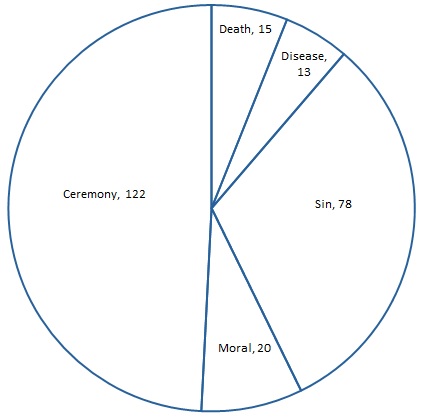
But there is another taxonomy we can apply to Torah. Rather than classifying laws by their duration, we can group them together by theme. Focusing solely upon the 248 positive commands, we find five main types of laws:
| Type | # of Laws | % of Positive Torah |
|---|---|---|
| Sin | 78 | 31.45 |
| Death | 15 | 6.05 |
| Disease | 13 | 5.24 |
| Moral | 20 | 8.07 |
| Ceremony | 122 | 49.19 |
| Total | 248 | 100.00 |
| This data derives from my own personal study of Torah. Although I am confident in the overall accuracy of the survey, I do not guarantee I have classified every law accurately, and therefore the percentages may slightly change if I find the need to reclassify a particular command. | ||
Here is a pie chart, displaying the same data as above in a different way:
Here is an example of each type of positive command:
| Type | Example | Positive Commmand # |
|---|---|---|
| Sin | A woman suspected of adultery has to submit to the required test | Command 223 (Numbers 5: 15 – 27) |
| Death | You must exile the unwitting homicide | Command 225 (Numbers 35: 25) |
| Disease | Until cleansed the leper must be bareheaded with clothing in disarray so as to be easily distinguishable | Command 112 (Leviticus 13: 45) |
| Moral | The Jew is required to love G-d | Command 3 (Deut 6:5) |
| Ceremony | The priests must also light the menorah daily | Command 25 (Exodus 27: 21) |
One is most certainly on the path to understanding if one can categorize the laws of Moses by both type and duration. After all, can one really say they understand the specific details of a law if they can’t even understand its general purpose and how long it is intended to last?
 TanakhAnew
Pingback: Are The Laws That Deal With Death Eternal? | TanakhAnew